
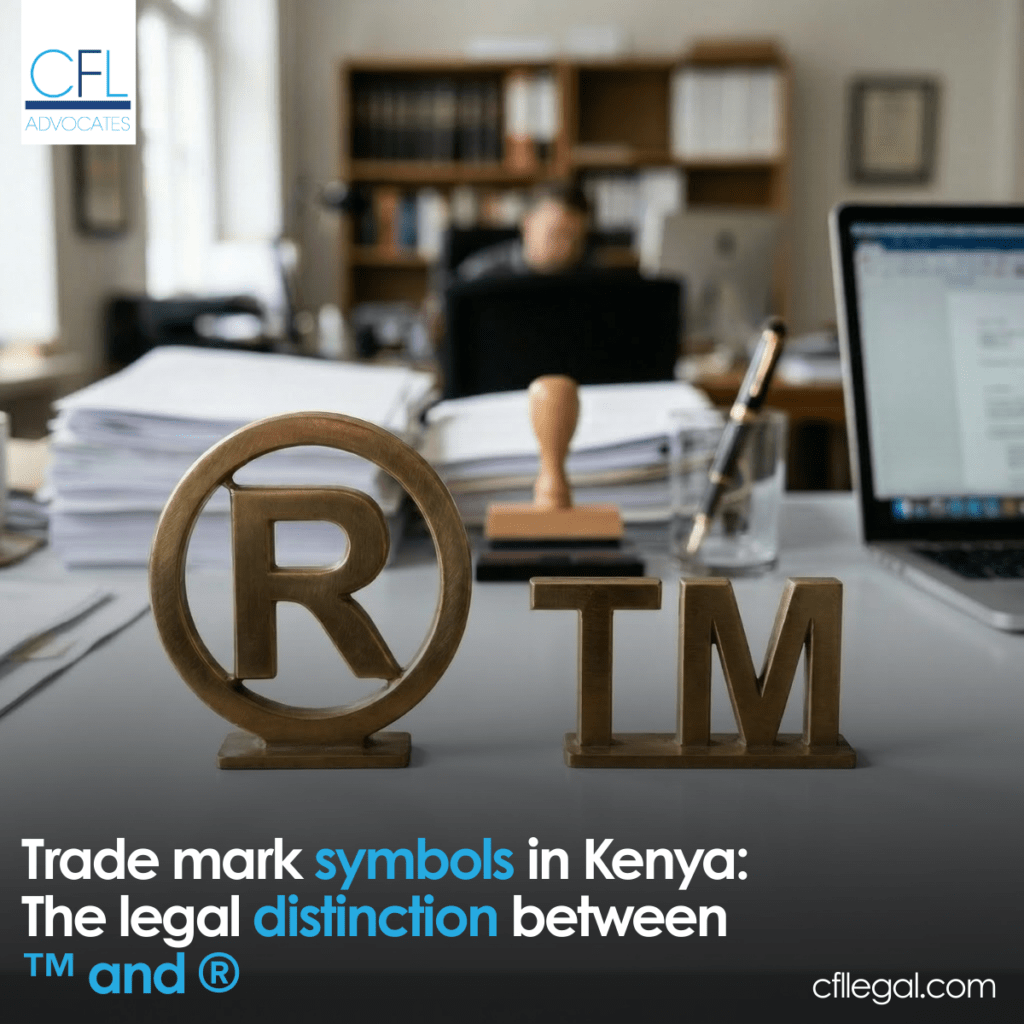
Intellectual property (IP) protection in Kenya is anchored in a robust legal framework that distinguishes between claimed rights and registered rights. As businesses navigate the competitive marketplace, the strategic use of trade mark symbols, specifically the ™ (Trade Mark) and ® (Registered) symbols, serves as a critical communication tool for brand owners.
In Kenya, trade marks are governed by the Trade Marks Act (Cap. 506) and administered by the Kenya Industrial Property Institute (KIPI). Understanding when and how to use these symbols is essential for securing your brand identity and avoiding legal pitfalls.
The ™ Symbol: Asserting a Claim
The ™ symbol is generally used to notify the public that a business claims rights to a mark, even if it has not yet been formally registered.
- Usage: It can be used as soon as a brand is launched or while a registration application is pending at KIPI.
- Legal Standing: Use of the ™ symbol does not grant statutory protection under the Trade Marks Act. Instead, it relies on Common Law rights, which protect against “passing off”.
- Benefit: It acts as a deterrent by signaling to competitors that the owner intends to defend the mark as a proprietary asset.
The ® Symbol: The Mark of Registration
The ® symbol is reserved exclusively for marks that have successfully completed the registration process and appear on the official Register of Trade Marks in Kenya.
- Prerequisite: It may only be used after a trade mark has been successfully registered.
- Exclusive Rights: Registration grants the proprietor the exclusive right to use the mark in relation to the specified goods or services throughout Kenya.
- Enforcement Advantage: Unlike unregistered marks, a registered trade mark allows the owner to sue for infringement directly under the Act, which is often easier to prove than a common law passing-off claim.
Legal Pitfalls: Section 58 of the Trade Marks Act
Using the ® symbol prematurely or incorrectly is not just a branding error; it is a criminal offense in Kenya. Under Section 58 of the Act, strict boundaries are set to prevent the public from being misled regarding the registration status of a mark.
1. Prohibited Representations
A person is guilty of an offense and liable to a fine if they make a false representation that:
- A mark is registered when it is not.
- A part of a registered trade mark is separately registered when it is not.
- A mark is registered for specific goods for which it is actually not registered.
- Registration gives an exclusive right that is actually restricted by limitations on the register.
2. Defining “Registered”
For legal purposes, using the word “registered” or any other word implying registration (such as the ® symbol) in Kenya is deemed to refer to registration in the Kenyan register.
3. The International Exception
The Act provides specific exceptions for international marks. Use of the word “registered” is permitted if:
- It is clearly stated (in characters at least as large) that the registration is under the laws of a foreign country where the registration is currently in force.
- The mark is used on goods specifically intended for export to that foreign country.
Conclusion
While the ™ and ® symbols are powerful tools for brand enforcement and commercialization, they must be used with precision. The Kenyan legal framework provides a strong foundation for IP protection, but it requires businesses to be proactive and compliant. Misrepresenting a mark’s status can lead to fines and may jeopardize the brand’s legal standing in future disputes.
As Kenya continues to positions itself as a regional digital and commercial hub, businesses should adopt a proactive stance toward trade mark management to avoid committing an offence under Section 58.
- Audit Your Branding: Regularly review packaging and digital assets to ensure the ® symbol is only used on marks that have a valid, current registration certificate from KIPI.
- Phased Marking: Use the ™ symbol during the application pendency period to establish a public claim without risking the penalties of Section 58.
- Territorial Awareness: Remember that the ® symbol implies Kenyan registration. Under Section 58(2)(a), if your mark is registered in another country but not Kenya, you must follow specific labeling requirements to avoid liability:
- The word “registered” must be used in physical association with other words.
- These accompanying words must be in characters at least as large as the word “registered”.
- The words must clearly indicate that the reference is to registration under the law of a country outside Kenya.
- The registration referred to must actually be in force in that foreign country.
For more information or assistance with trade mark registration and enforcement, please contact us at info@cfllegal.com.