
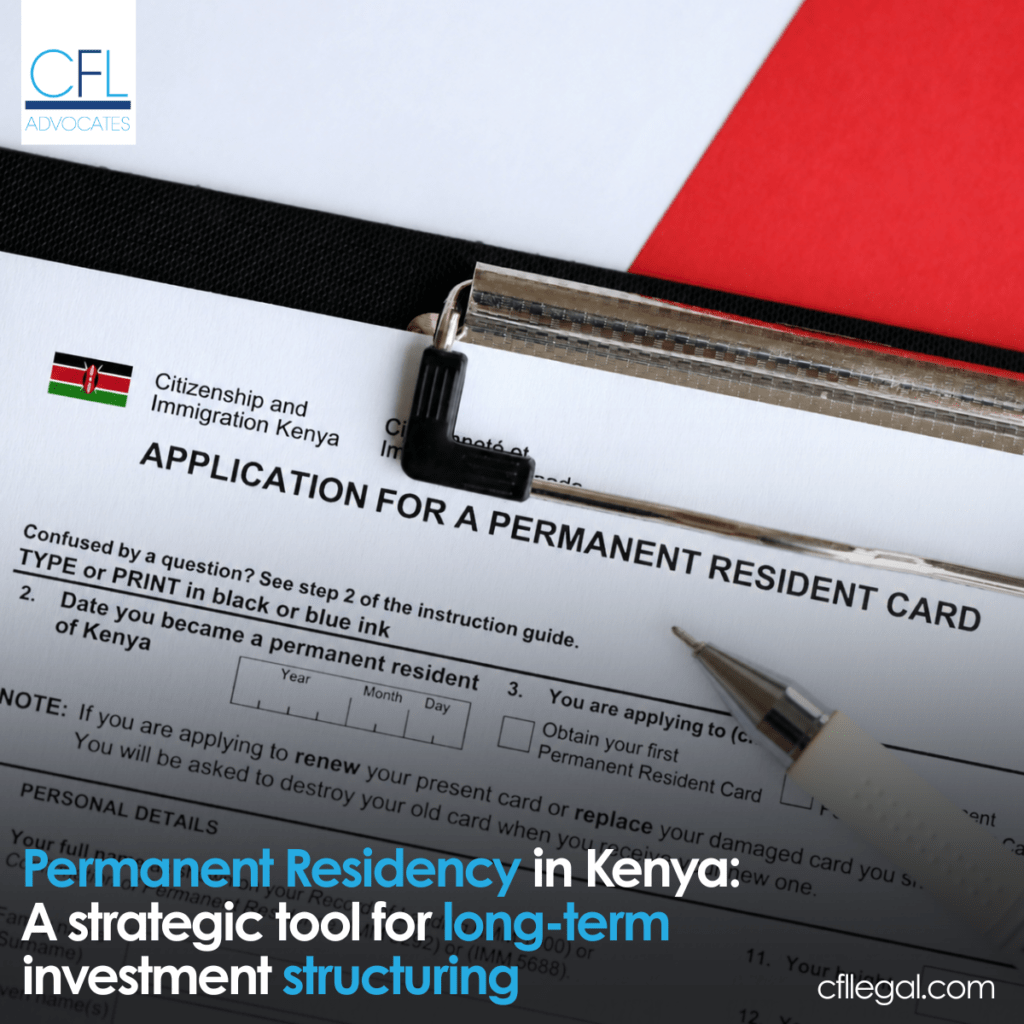
In an era where capital is increasingly mobile and investment frontiers continue to expand, Kenya has firmly positioned itself as a compelling destination through an economic gateway to East Africa, a hub for innovation, and a jurisdiction rich in opportunity. Yet, for many foreign nationals, particularly investors and senior professionals, one defining question ultimately shapes the depth of their engagement:
How do you move from merely operating in Kenya to truly belonging within its legal and economic fabric?
The answer, in many cases, lies in permanent residency (PR), a status that transforms one’s relationship with the country from temporary participation to long-term integration.
Legal Framework governing Permanent Residency
Permanent residency in Kenya is governed primarily by the Kenya Citizenship and Immigration Act, 2011(the Act), which defines a permanent resident as a person who has acquired such status in accordance with its provisions.
The Act outlines four key categories of individuals eligible to apply for permanent residence:
- Category A: Ex-Citizens of Kenya
This category applies to Kenyan citizens by birth who have since renounced or lost their citizenship and are unable to hold dual citizenship under the laws of their country of domicile.
- Category B: Lawful Residents (Most relevant for investors)
This is the most relevant pathway for foreign investors and professionals.
To qualify, an applicant must have held a Kenyan work permit for at least seven (7) years and have been continuously resident in the country for three years immediately preceding the permanent residence application.
- Category C: Children of Kenya Citizens
This applies to children of Kenya Citizens born outside the country and who have acquired foreign citizenship in their country of residence/domicile.
- Category D: Spouses of Kenyan Citizens
This applies to spouses of Kenyan citizens married for at least three years. Applicants are required to provide sufficient proof of marriage and family life besides the documentation furnished, and may be required to attend an in-person interview to verify the authenticity of the relationship.
Rights and Privileges: what permanent residency offers
Permanent residency in Kenya confers a suite of rights and privileges that can be enjoyed by people with permanent residency status in Kenya. These include the right to:
- enter and remain in Kenya, subject to the provisions of the Act;
- be employed or engage in business without the need for a work permit;
- to attend educational facilities;
- to own leasehold property legally in Kenya;
- to move and settle anywhere in Kenya;
- to access and enjoy social services and facilities in Kenya;
- comply with residency obligation as may be prescribed;
- be provided with a permanent residence certificate as prescribed under the regulations; and
- comply with such other conditions as shall be imposed under the Regulations.
However, these rights are accompanied by obligations. Permanent residency may be revoked in certain circumstances, including:
- Fraud, misrepresentation, or concealment of material facts;
- Failure to comply with residency obligations;
- Assisting an enemy of Kenya in times of war; or
- Violation of the provisions of the Act.
Processing costs
Ex-Kenyan citizens and lawful residents pay Kshs 50,000 in application processing fees and a further Kshs 100,000 and Kshs 750,000 respectively for issuance of the permanent residence certificate.
Spouses of Kenyan citizens pay Kshs 50,000 in application processing fees and Kshs 150,000 for issuance of the permanent residence certificate.
Children of Kenyan citizens who have acquired nationality of countries that do not allow dual citizenship pay Kshs 20,000 in application processing fees and a further Kshs 750,000 for issuance of the permanent residence certificate.
Conclusion
Permanent residency in Kenya is more than an administrative status, it is a strategic legal tool that offers stability, operational efficiency and enhanced investment security.
However, securing it requires careful planning and precise execution. The difference between delay and success often lies in how effectively an application is structured and presented.
Engaging experienced advocates ensures that this process is navigated with clarity, confidence and strategic foresight.