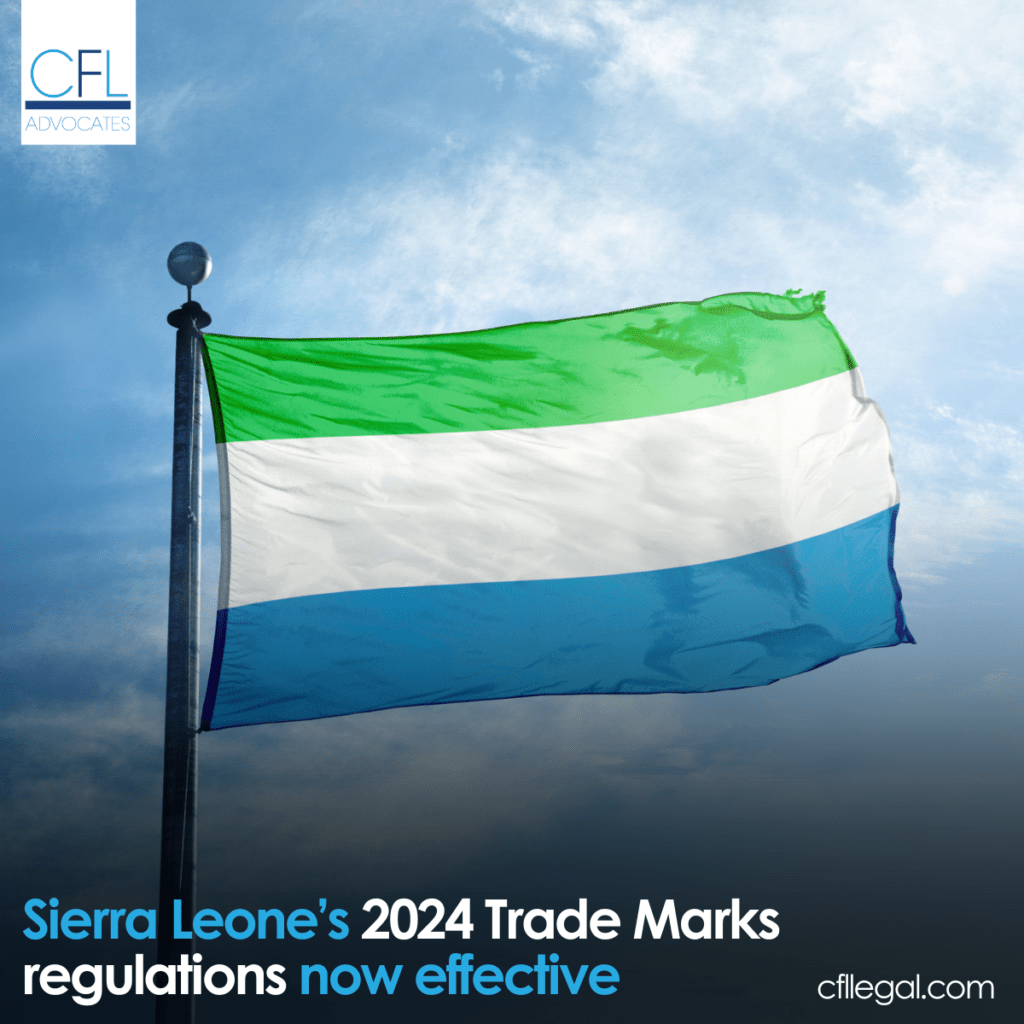
The Trade Marks Regulations, 2024, have officially come into effect in Sierra Leone, following their publication as Statutory Instrument No. 19 of 2024. These regulations establish a detailed procedural framework for trade mark practice in the country, providing clearer guidance for both national and international filings, enforcement, and administrative procedures before the Trade Marks Registry.
Key Updates for Brand Owners and Practitioners
- Mandatory Use of Prescribed Forms
The Regulations require all trade mark-related actions to be submitted on the specified statutory forms found in Schedule 2. These forms cover a wide range of processes, including:
- Filing new trade mark applications
- Oppositions and counter-statements
- Renewal and restoration of trade mark rights
- Assignments, transmissions, and other recordal matters
- Invalidation and non-use cancellation proceedings
Applications that fail to comply with the prescribed formats may be rejected, making strict adherence to these forms essential.
- Structured Procedural Timelines
The new framework replaces previous ambiguities with definitive deadlines for trade mark prosecution, to ensure legal certainty. These include;
- Priority Claims: If a certified copy of the earlier application is not available at filing, it must be furnished within 3 months, extendable by another 3 months if the delay was beyond the applicant’s control.
- Acceptance & Publication: Upon acceptance, the Registrar notifies the applicant to pay the publication fee within one month.
- Opposition Window: Third parties have 3 months from the date of publication in the Gazette to file an opposition.
- Extensions: The Registrar now has the explicit authority to grant extensions. An opposition period can be extended (for an additional 3 to 6 months) if requested before the initial deadline.
- Counter-Statements: Once notified of an opposition, an applicant has 1 month (extendable to 3 months) to file a counter-statement or risk the application being deemed abandoned.
- Renewal, Removal, and Reinstatement: A request for renewal must be made during the 6 months preceding the expiry of the registration. Additionally, the Registrar is mandated to notify the proprietor of an approaching expiration between 1 and 3 months before the deadline. A second notice may be sent between 14 days and one month before expiry if no fee has been received. If rights lapse, a request for reinstatement must be made in writing within 2 months of the lapse, subject to the reinstatement fee.
- Clarification on Madrid Protocol Procedures
The Regulations also provide guidance on procedures under the Madrid Protocol for international registrations involving Sierra Leone.
For international registrations designating Sierra Leone, specific timelines now apply to safeguard local and international rights:
- Opposition to International Marks: A notice of opposition must be filed within 3 months from the date of publication.
- Provisional Refusal Response: If the Registrar issues a provisional refusal, the holder has 3 months from the date of notification by the International Bureau to request a review or hearing.
- International Counter-Statements: The holder must file a counter-statement within 3 months of the notification sent by the International Bureau.
- Appeals: Any person aggrieved by a decision regarding an international registration may appeal to the Tribunal within 2 months of the decision.
- Transformation: If an international registration is cancelled at the Office of Origin, the holder has 3 months from the cancellation date to apply for a national “transformation” application in Sierra Leone.
Despite this clarity, the effective operation of these procedures relies on the full readiness of the Trade Marks Registry, including reliable electronic records and timely coordination with WIPO. Until these systems are fully functional, filing national applications remains the most dependable option for securing protection in Sierra Leone.
- Updated Fees and Administrative Guidelines
Alongside the procedural shifts, a revised fee schedule has been introduced.
Brand owners should note that trade mark fees have been increased to reflect current administrative costs. The fees are now differentiated between foreign applicants (payable in USD) and national applicants (payable in LE), with fees for foreign applicants being higher than those for nationals.
Conclusion
The enactment of the Trade Marks Regulations, 2024 marks a significant step in modernising trade mark practice in Sierra Leone. While the reforms improve certainty, efficiency, and alignment with international standards, they also demand careful attention to procedural compliance to protect rights effectively.
For further information or assistance please contact our Intellectual Property team at cfltrademarks@cfllegal.com.